
PDF Guides
How to Organize PDF Pages: Reorder, Rotate, Remove and Crop
When a PDF's pages are in the wrong order, contain a section you no longer need, or mix documents that were scanned together, organizing lets you fix all of it visually — by dragging page thumbnails instead of editing the file blind.
By GaryLast updated 6 min read
Organize a PDFWhat page organizing covers
Organizing a PDF is really three tools in one: reordering pages, deleting the ones you don't need, and rotating any that are sideways — all from the same visual thumbnail view.
How to organize a PDF
Because you can see every page as a thumbnail, the process is visual rather than guesswork.
- Open your PDF
- View every page as a thumbnail
- Drag pages into the order you want
- Delete or rotate individual pages as needed
- Download the reorganized PDF
A common use case: scanned batches
Documents scanned from a feeder tray often come out in the wrong order, with a stray blank page or two, and a handful of sideways pages. Organizing lets you fix the whole batch — reorder, delete the blanks, rotate the sideways ones — in one pass instead of three separate tools.
Which tool to use: Organize, Reorder or Merge?
Use Reorder Pages when you know the order you want as numbers. Use Organize PDF when you would rather drag page thumbnails around and rotate or delete pages at the same time. If the pages come from several files, Merge PDF lets you arrange files and pages as you combine them.
Reordering: how pages end up out of order
This usually happens when pages are scanned out of sequence, when several PDFs are merged in the wrong order, or when an export process doesn't preserve the order you expected. Fixing it after the fact is much faster than rescanning or rebuilding the document from scratch.
Reordering by page number
The reorder tool starts with the pages in their original order. Edit the list so every page number appears exactly once, separated by commas, in the order you want. For a 5-page file, 1,3,2,4,5 swaps pages 2 and 3, and the Reverse page order button flips the whole document in one click.
If a number is missing or repeated, the tool tells you before it builds the file, so you cannot accidentally drop a page.
Rotating: why pages end up sideways
Rotated pages usually come from scanning a document in landscape orientation, taking a photo of a page sideways, or receiving a file that was saved incorrectly by another program.
The problem compounds when a PDF has some pages right-side up and others sideways — common with multi-page scans from an automatic feeder.
How to rotate a PDF in your browser
You don't need Adobe Acrobat or any desktop software to fix page orientation.
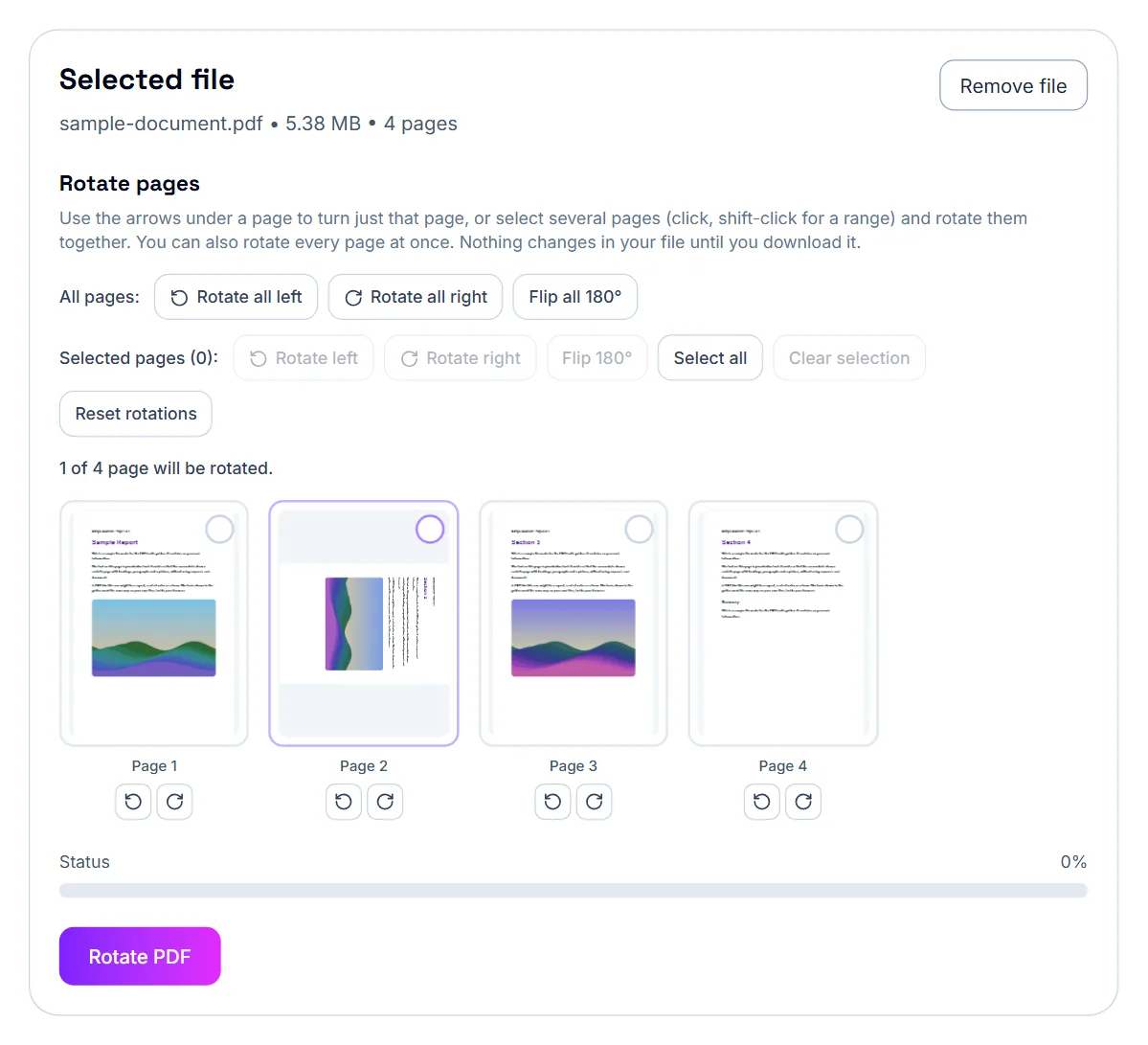
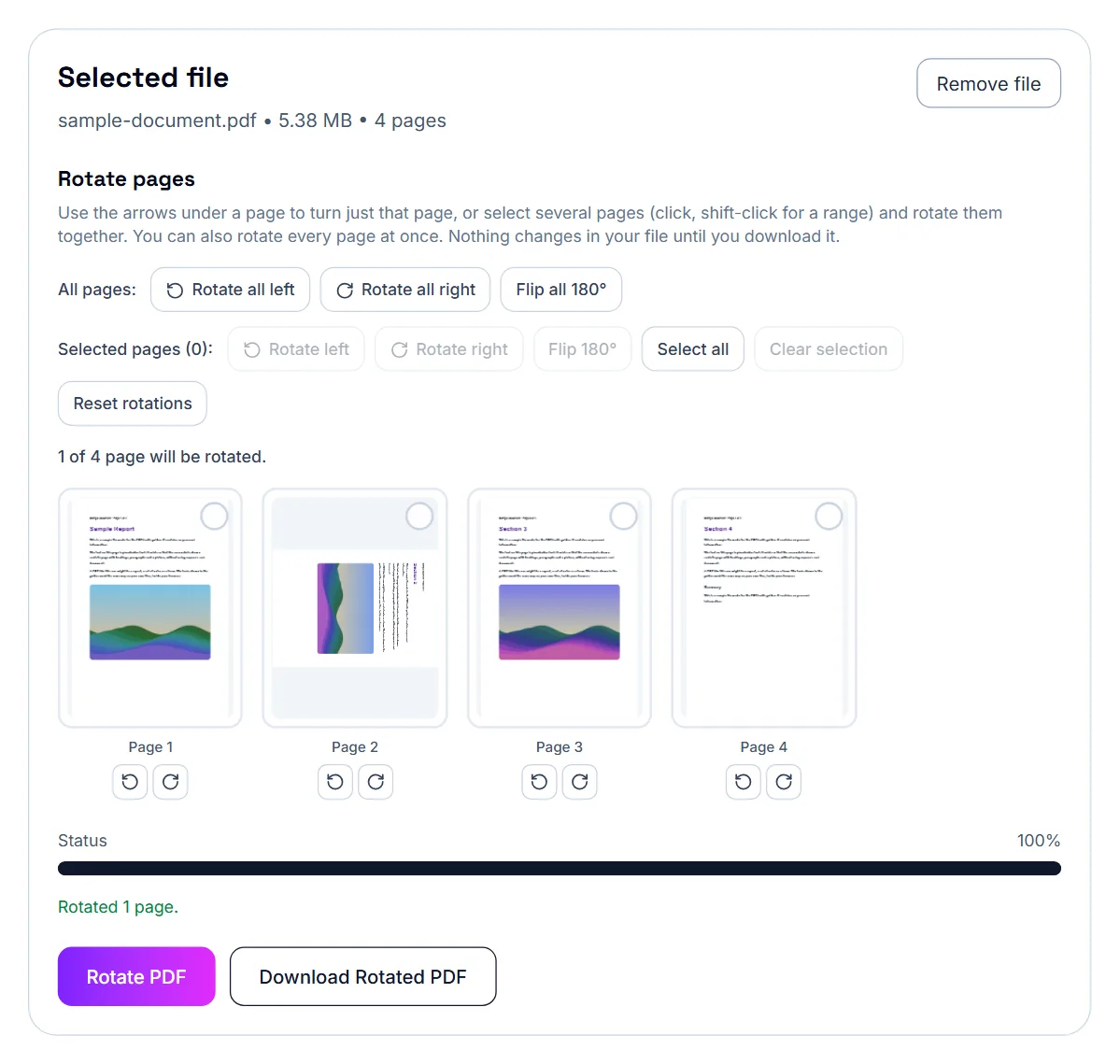
- Open the PDF rotate tool and choose your file
- Select the pages that need rotating (or rotate all of them at once)
- Use Rotate left, Rotate right or Flip 180°
- Download the corrected PDF
Fixing just some pages, not all
Rotate PDF turns individual pages independently, which matters for scanned packets where only a few pages came out sideways. You shouldn't have to rotate the whole document just to fix one page.
Removing pages: when to delete rather than split
Removing pages is different from splitting: splitting extracts a section into a new file, while removing pages deletes them from the document and keeps everything else together as one file. If you just want a cleaner version of the same document minus a page or two, removing is the right tool.
If you would rather keep a few pages and drop everything else, it is often quicker to use Split PDF and pick the pages you want to keep. And if you need to see the pages while you decide, Organize PDF shows every page as a thumbnail and lets you delete, rotate and reorder them.
How to remove pages from a PDF
Remove Pages works from page numbers rather than thumbnails, so it helps to know which pages you want gone before you start. Open the PDF in any viewer first and note the page numbers as the viewer shows them, starting from 1.
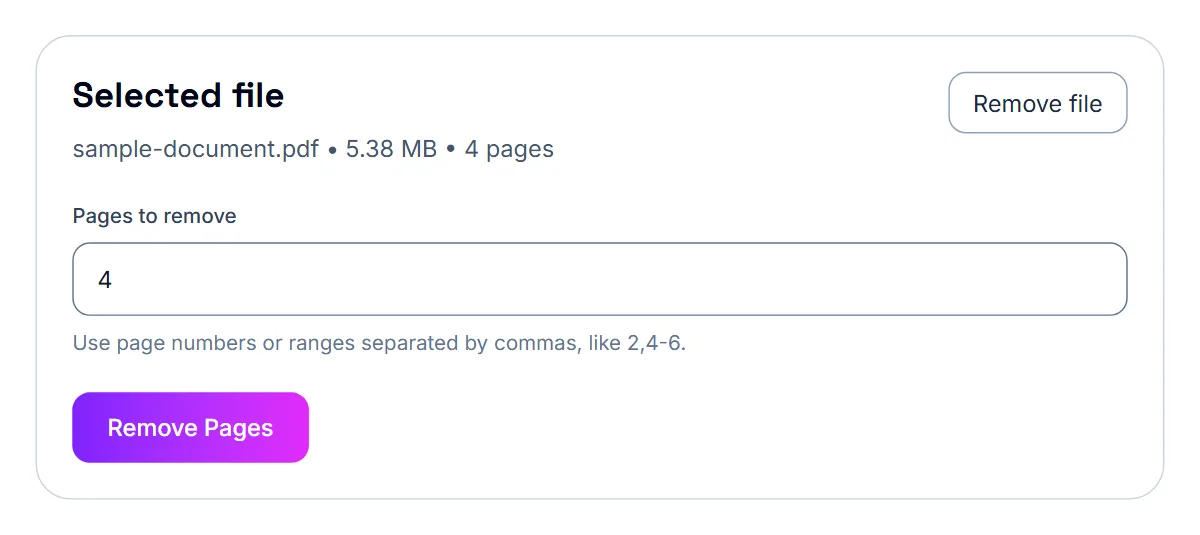
- Open Remove Pages and select Select PDF File, or drop the PDF onto the box
- Check the line under Selected file: it shows the file name, its size and how many pages it has
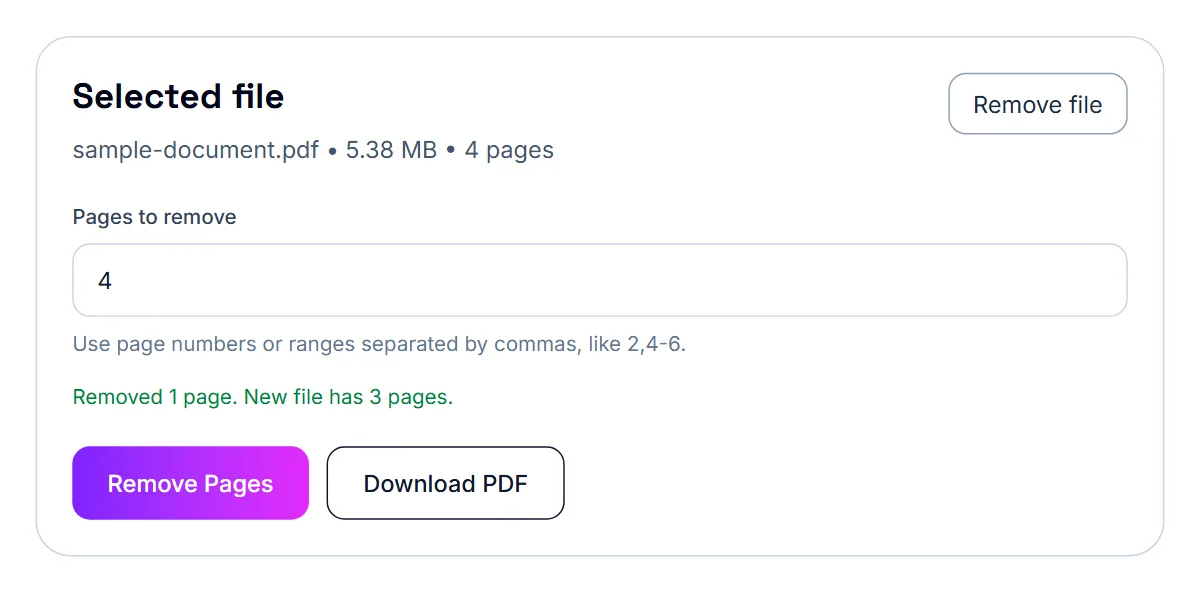
- In Pages to remove, type the pages to delete, for example 4, or 2,4-6 for page 2 and pages 4 to 6
- Select Remove Pages. The status line tells you how many pages were removed and how many the new file has
- Select Download PDF to save the shorter file
Writing page numbers and ranges
Separate pages and ranges with commas. A range is two page numbers joined by a hyphen and includes both ends, so 4-6 removes pages 4, 5 and 6. You can mix the two in any order, such as 1,3,7-9.
The numbers are the physical page positions in the file, counted from the first page. They are not the page numbers printed on the pages, which often differ when a document has a cover, a contents page or Roman-numbered front matter. If page 1 of your report is the fourth page of the PDF, type 4.
Blank pages: why they show up in scanned PDFs
Most scanners default to duplex (two-sided) scanning even when your paper is only printed on one side, which adds a blank page for every sheet. Separator sheets, cover pages, and the occasional scanning glitch add a few more. In a 40-page scan, that can mean a dozen blank pages mixed in.
How to remove blank pages automatically
The tool checks each page's content and flags the ones that are effectively empty, so you don't have to scroll through and check manually.
- Open your scanned PDF
- Let the tool scan each page and detect the blank ones
- Select Remove Blank Pages; the status line says how many pages were removed
- Download the cleaned-up PDF
What counts as "blank"
A page with a stray mark, a faint scanner line, or a bit of background noise from the glass isn't always perfectly empty — detection is tuned to catch pages that are blank for practical purposes, not just pages with zero pixels different from white. The remaining pages keep their original scan quality; nothing about them is re-compressed or altered.
Cropping: when it actually helps
Scanned pages often come with wide, uneven margins or a dark border from the scanner bed. Slide decks exported to PDF sometimes carry excess white space around the content. In both cases, cropping tightens the page so it reads better on screen and prints cleaner.
How to crop a PDF
Crop PDF trims a percentage from each edge of the page.
- Open your PDF
- Enter how much to trim from the top, bottom, left and right, as a percentage of the page
- The same trim is applied to every page
- Download the cropped PDF
Cropping vs. resizing
Cropping removes part of the page permanently — it doesn't shrink or scale the content, it cuts away what's outside the selected area. If you need to make a page smaller without losing any content, resizing or adjusting print settings is a better fit than cropping.
Frequently asked questions
Can I see all my pages before making changes?
Yes, the tool shows every page as a thumbnail so you can plan the new order visually before applying anything.
Can I delete pages and reorder pages at the same time?
Yes, reordering, deleting, and rotating can all be done in the same session before you download the final file.
Does this work for very long documents?
Yes, though for very long documents it can help to delete unneeded pages first so there's less to reorder visually.
Can I move a single page anywhere in the document?
Yes, you can drag any page to any position, including moving it to the very beginning or end.
Will reordering change the page content or quality?
No, reordering only changes the sequence of the pages. The content of each page stays exactly the same.
How do I reverse the page order of a scanned document?
Use the Reverse page order button in the reorder tool. It is useful when a stack of pages was scanned back to front.
Can I remove more than one page at a time?
Yes. List every page and range you want gone, separated by commas, such as 2,5,8-10, and they are all removed in one step.
Does removing pages affect the rest of the document?
No. The pages you keep stay as they were, in the same order. Only the pages you list are removed.